Mercedes-Benz in cooperation with Daimler-Benz, AMG, Baby supercar produced by the SLS model gullwing doors.
Baby SLS information was submitted by the Director of the Division of Development and performance AMG, Christoph Jung told Auto Express. Later the car was ready to compete with the Porsche 911.
Regarding the kitchen runway, the car is equipped with a new twin-turbo engine with a capacity of 5.5-liter engine that can generate power 550 PS, rear-wheel drive system, seven-speed transmission with double clutch.
Thus the acceleration from 0 to 100 km / h takes only 4 seconds and capable of up to a maximum power of 300 km / hour.
Baby Mercy SLS is also efficient because it is equipped with sto-start system. Improved engine performance but have a target more efficient fuel consumption.
Furthermore, a car with gullwing doors that will be sold in the UK is priced at 168,000 pounds attau Rp2, 3 billion and be ready to compete with the Porsche 911 sports car.
Showing posts with label 2013. Show all posts
Wednesday, October 5, 2011
Friday, September 30, 2011
Citroen C4 Aircross
More than 100,000 new Citroën C4 vehicles have rolled of the assembly line since the model was launched one year ago. Following on from this commercial success, the Marque is now extending its C4 range with an original model: the Citroën C4 Aircross. This new vehicle reviews the conventional cues of compact SUV design. By combining style and technological innovation in a single car, the Citroën C4 Aircross is ideally suited to modern lifestyles that introduce a sense of escape into everyday activities. This new body style draws upon the Marque's technological excellence, combining the grip of an off-roader with the ride and driveability of a saloon. Available in 2-wheel and 4-wheel drive versions, depending on the engine, the Citroën C4 Aircross will be launched in the first half of 2012 and will be one of the front-runners in its segment in terms of CO2 emissions.
The styling of the Citroën C4 Aircross draws upon the Marque's DNA, combining the vitality of the other models in the range with the powerful styling of an off-roader.
The distinctive styling includes a front end of horizontal lines with aerodynamic vents at the extremities, accentuating the vehicle's compact appearance. The contours of the bonnet, which is visible from the driver's seat, the wide wheel arches and the reduced overhang all enhance the impression of robustness produced by this unique silhouette.
Close attention went into every detail and each part is designed to combine style and performance. The Citroën C4 Aircross' light signature, visible by day and at night, is formed by the LEDs at the front, which are vertically aligned in the aerodynamic vents. The shape of the large 18-inch wheels and the rear lights, directly inspired by the Hypnos concept car, has been reworked for optimal air flow and reduced CO2 emissions.
The sophisticated design of the Citroën C4 Aircross includes repeater lights in the door mirrors, light guides in the rear lights and a rearview camera built into the chrome trim on the tailgate.
The expressive style draws upon Citroën's distinctive design cues. Seen from the side, the inverted shark fin wing, which also hints at the glass side surfaces of the Hypnos concept car, is decorated with a chrome compass to show that the model is a member of the brand's SUV family.
A smart vehicle with transmission to suit all needs
With its latest-generation four-wheel transmission system, Citroën C4 Aircross boasts perfect roadholding under all conditions. This technology allows the car to be driven permanently in four-wheel drive mode, while the torque is optimally distributed between the front and rear wheels.
Using the single control positioned behind the gear lever, drivers can manually select one of the three transmission modes to meet their needs and their wishes: 2WD for optimal fuel consumption, 4WD,
which automatically distributes the torque between the front and rear axles, or lock mode, which increases the torque transmitted to the rear wheels for more grip under severe conditions.
Standard-setting CO2 emissions
Citroën C4 Aircross fulfils the brand's commitments to environmental protection with its HDi 110 engine, mated to a 6-speed manual gearbox, making this model is one of the front-runners in its segment in terms of CO2 emissions. And the HDi 110 engine will be available with 2WD and 4WD, so that everyone can choose the version that is best suited to their lifestyle.
Right from launch, the Citroën C4 Aircross will also benefit from the performance of the HDi 150 engine (also available with 2WD and 4WD with a 6-speed manual gearbox) and a 115 bhp 1.6i petrol engine (available in a 2WD version with a 5-speed manual gearbox).
Compact, manoeuvrable and a pleasure to drive
With its compact dimensions (4.34m long, 1.79m wide, 1.63m high), the outstandingly manoeuvrable (10.6m turning circle) Citroën C4 Aircross is at home in towns and cities. The comfort of this 5-seater is worthy of a saloon in the next segment up, while the 442-l boot comfortably meets the demands of modern life. The chassis and suspension were specially developed for a drive that is faithful to Citroën's values, offering the ideal compromise between comfort and roadholding.
Escape to a new mindset
Take to the road with complete peace of mind. The raised driver's position in the Citroën C4 Aircross offers a clear view of the road and surroundings.
Occupants of the Citroën C4 Aircross can enjoy blue skies even in the city, thanks to the large panoramic glass, which bathes the cab in light, contributing to the passengers' sense of well-being. At night, the atmosphere is cosier, and the panoramic roof is lit up by the LED light guides built into the roof.
The ergonomics of the highly functional drive station are designed so that drivers can get to know the car quickly and for easy everyday use. To make the drive and the ride even more comfortable, the Citroën C4 Aircross is crammed with equipment, from the hands-free access and starter, to the GPS navigation system with its touch-sensitive screen, rearview camera, transmission mode selector, USB port and Bluetooth connection for portable audio players.
BMW 5 ActiveHybrid
BMW takes the development of intelligent hybrid drive systems to the next level with the introduction of the BMW 5 ActiveHybrid - another series-produced model in which a combustion engine and electric motor join forces to enhance both efficiency and the brand's hallmark driving pleasure. The BMW 5 ActiveHybrid brings together a BMW TwinPower Turbo six-cylinder in-line engine, an electric drive system and an eight-speed automatic gearbox for the first time. The latest generation of BMW ActiveHybrid technology also adds precisely controlled - and therefore extremely effective - energy management to the mix.
All of which gives the BMW 5 ActiveHybrid an exceptional balance of performance and fuel economy for the premium executive car class. Its drive system generates combined output of 250 kW/340 hp, allows the car to be driven on electric power alone up to 60 km/h (37 mph), accelerates the BMW 5 ActiveHybrid from 0 to 100 km/h (62 mph) in 5.9 seconds, limits average fuel consumption to between 6.4 and 7.0 litres per 100 kilometres (44 - 40 mpg imp) and has CO2 emissions of just 149 - 163 grams per kilometre (figures according to EU test cycle, may vary according to the tyre format specified).
The 225 kW/306 hp six-cylinder in-line engine with BMW TwinPower Turbo technology in the BMW 5 ActiveHybrid is the same unit renowned for its free-revving capability, pulling power and efficiency in the BMW 535i. The electric motor, meanwhile, develops 40 kW/55 hp and is supplied with energy by a high-performance lithium-ion battery integrated into the luggage area.
A harmonious blend of power from the two drive systems is transferred to the rear wheels by the eight-speed automatic gearbox. In addition to its full-hybrid construction, which enables purely electric and therefore emission-free driving in urban conditions, the BMW 5 ActiveHybrid boasts not only the sportiest performance in its market segment but also a double-digit percentage improvement in fuel economy over the BMW 535i.
In order to fully exploit the potential of the BMW ActiveHybrid technology, the intelligent energy management of the power electronics in the BMW 5 ActiveHybrid uses a host of innovative functions to ensure the drive system runs efficiently. The lithium-ion high-performance battery is charged when the car is coasting or braking, the electric motor performing the role of a generator feeding energy into the high-voltage battery. By contrast, under acceleration the electric motor takes on a boost function. Here, it assists the petrol engine by generating an ultra-dynamic burst of power, lending the sedan's sporty driving experience a noticeably sharper edge. Added to which, while coasting at speeds of up to 160 km/h (100 mph) in ECO PRO mode, the combustion engine can be switched off and fully decoupled. This coasting mode combines comfortable driving with optimum utilisation of the kinetic energy already generated. To avoid periods with the engine running at idle - at junctions or in traffic tailbacks, for example - the BMW 5 ActiveHybrid is equipped with a hybrid start-stop function. Plus, the power electronics in the BMW 5 ActiveHybrid are linked up with the standard-fitted navigation system Professional. This allows forward-looking analysis of the driving situation, enabling the drive components to be primed to deliver maximum efficiency (the effect may vary according to the quality of the available navigation data). All the hybrid-specific components of the drive technology and energy management systems have been developed specially for use in the BMW 5 ActiveHybrid. The result is an extremely well-rounded overall concept, which also provides a convincing demonstration of the BMW ActiveHybrid technology's qualities out on the road. Needless to say, all of the new hybrid components are designed to last for the life of the vehicle.
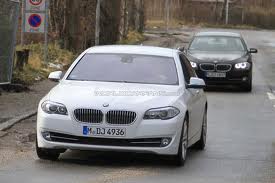
The BMW 5 ActiveHybrid sees the sporty yet elegant body design of the BMW 5-Series Sedan complemented by bespoke touches which highlight the identity of its drive technology. The "ActiveHybrid 5" lettering on the C-pillars, BMW kidney grille with galvanised slats and exhaust matt chrome tailpipes set the exterior apart from the other models in the range. Available as an option, meanwhile, are 18-inch Streamline light-alloy wheels displaying exceptional aerodynamic efficiency. The BMW 5 ActiveHybrid is the only model in the BMW 5-Series line-up to be available in the exterior paint shade Bluewater metallic, and it also stands out visually from all other 5-Series variants with door sill strips bearing "ActiveHybrid 5" lettering, an aluminium plate on the centre console with the same ID, a bespoke engine cover and the visible "ActiveHybrid Power Unit" inscription on the special casing for the high-performance battery accommodated in the luggage area.
The selection of interior colours, upholstery and interior trim elements reflect the range offered for the other BMW 5-Series Sedan variants. And added to the standard-fitted array of comfort-enhancing features is not only the navigation system Professional, but also a 4-zone climate control system with stationary air conditioning. A wide range of driver assistance systems and BMW ConnectedDrive mobility services, as well as virtually all the other optional extras available for the conventionally powered BMW 5-Series Sedan, can also be specified for the BMW 5 ActiveHybrid.
Innovative combination: award-winning six-cylinder in-line engine, newly developed electric drive system.
This is the first time that a six-cylinder in-line engine has been included as part of a BMW ActiveHybrid system. The 3.0-litre petrol unit, which develops 225 kW/306 hp and peak torque of 400 Newton metres (295 lb-ft), represents a passport to increased driving pleasure and efficiency. The BMW TwinPower Turbo technology of the six-cylinder engine, which has already won the international Engine of the Year Award two years in succession, comprises a twin-scroll turbocharger, High Precision Direct Injection and VALVETRONIC variable valve timing.
The synchronous electric motor of the BMW 5 ActiveHybrid is integrated into the housing of the eight-speed automatic gearbox, saving space. The link-up between the electric motor and gearbox is controlled by a clutch and the motor's operating temperature is regulated by the combustion engine's cooling system. The electric drive system develops 40 kW/55 hp and makes 210 Newton metres (155 lb-ft) of torque available from rest. The motor is supplied with energy by a lithium-ion high-performance battery, likewise specially developed for the BMW 5 ActiveHybrid. The high-voltage battery is encased in a special high-strength housing and positioned between the wheel arches in the luggage area, providing it with optimum protection. It consists of 96 cells, has its own cooling system and offers usable energy capacity of 675 Wh. The integration of the lithium-ion high-performance battery into the luggage area reduces the load capacity of the BMW 5 ActiveHybrid to 375 litres, 145 litres lower than that of a BMW 5-Series Sedan variant powered purely by a combustion engine.
The BMW 5 ActiveHybrid has both a conventional 14-volt power supply and a high-voltage supply with an operating voltage of 317 volts. They are linked up by a voltage transformer ensuring that maximum electric energy can be used to enhance driving dynamics and comfort in any operating phase. Like the electric motor, the air conditioning compressor is also fed with power from the lithium-ion high-performance battery exclusively via the high-voltage supply. This ensures a pleasant interior climate, even when the combustion engine is switched off - i.e. when the car is at a standstill, operating purely on electric power or in coasting mode. In addition, the stationary climate control function can be used to cool the interior before the engine is started up.
Intelligently controlled hybrid technology: unprecedented precision for superior efficiency.
Up to a speed of 60 km/h (37 mph), the BMW 5 ActiveHybrid can operate in all-electric mode for zero emissions in town. The lithium-ion high-voltage battery can store sufficient energy to give an all-electric driving range of up to four kilometres (approx. 2.5 miles) at an average speed of 35 km/h (22 mph).
The internal combustion engine is only started when the driver requires more power: it is then engaged automatically. The electric motor provides a "boost" function to supplement the engine when accelerating. Maximum combined power is 250 kW/340 hp, with maximum torque of 450 Newton metres. Under combined ICE/electric power, the BMW 5 ActiveHybrid delivers a 0 to 100 km/h (62 mph) acceleration time of 5.9 seconds.
Hybrid-specific Auto Start-Stop function and coasting mode.
Thanks to the specially designed Hybrid Auto Start-Stop function, there are no compromises on comfort even when the vehicle is stopped in traffic for longer periods - after the internal combustion engine is shut off, the automatic climate control simply runs off the lithium-ion battery. When the driver releases the brake, the vehicle will restart on either the electric motor alone or the electric motor and the petrol engine, depending on the high-voltage battery's current charge level and on how much power the driver wants.
Another innovation being pioneered in the BMW 5 ActiveHybrid further improves efficiency by shutting the internal combustion engine down not only when the vehicle is stationary, or when driving in town, but also on overrun. In the BMW 5 ActiveHybrid, this coasting mode is available at any speed up to 160 km/h (100 mph). Coasting mode switches off the petrol engine and disconnects it from the drive shaft. From this point on, the BMW 5 ActiveHybrid continues moving soundlessly, with zero emissions and with no engine braking effect. The potential efficiency improvements are further enhanced by tyres with reduced rolling resistance. In coasting mode too, as with all-electric mode for urban driving, all safety and comfort functions remain fully operational.
Intelligent energy management with proactive analysis of the driving situation.
The advanced power electronics coordinate the operation of the internal combustion engine and electric motor with precise reference to the driving situation. For even more efficient energy management in the BMW 5 ActiveHybrid, this functionality has been extended to include proactive analysis of the driving situation. To support this, the power electronics are integrated with the standard-fitted Professional navigation system, which means they can access and analyse data indicating an upcoming change in external conditions or driver requirements at a very early stage. Based on this analysis, the vehicle can be prepared in advance for the relevant requirements so that all powertrain systems and the on-board electronics are managed appropriately and in such a way as to make the most efficient possible use of the available energy.
Factors that may cause a change in powertrain operating strategy include the topography of the route and speed limits. For example, if the system knows that a hilly stretch is coming up soon, the BMW 5 ActiveHybrid can invest all the high-voltage battery's electrical energy in providing supplementary driving power, since the battery will be recharged "at no cost" during the subsequent descent. On longer downhill sections the electric motor's generator function, too, can be enlisted to recharge the high-voltage battery with no loss of speed. The operating strategy can also be managed so as to ensure that the high-voltage battery is as fully charged as possible when nearing the end of the journey, thereby increasing the electric driving range on the "last lap".
The operating status of the powertrain components is shown in intuitive, model-specific displays in the instrument cluster and in the Control Display of the BMW 5 ActiveHybrid. As well as the energy flow and energy recuperation display, these include a further gauge next to the rev counter which shows the boost effect being provided by the electric motor during acceleration. A display in the iDrive interface provides a variety of information - for example on the lithium-ion high-voltage battery's current charge level and the power-sharing between the internal combustion engine and the electric motor in the course of a journey.
Exceptional hybrid model, typical BMW 5-Series: highest standards of driving dynamics, safety and comfort.
The chassis specifications of the BMW 5 ActiveHybrid include a double-wishbone front axle and integral rear axle, electromechanical power steering including the Servotronic speed-sensitive power assist function, a high-performance brake system and 17-inch alloy wheels. Dynamic Damper Control, featuring electronically controlled damping, is optionally available. The Dynamic Stability Control (DSC) system, which stabilises the vehicle by applying braking pressure and reducing engine power, also incorporates functions such as Dynamic Traction Control (DTC), the Anti-lock Braking System (ABS), Cornering Brake Control (CBC), Dynamic Brake Control (DBC), Brake Assist, Fading Compensation, a Dry Braking function and Start-Off Assistant.
The hybrid-specific safety features, which protect the lithium-ion high-voltage battery and the power electronics, are integrated in the BMW 5-Series' elaborate integrated active and passive safety concept. In a collision, high-strength structural components and large deformation zones help to keep impact forces away from the passenger cell and also from the hybrid drive components. Other standard safety systems on the BMW 5 ActiveHybrid include front and side airbags, side curtain head airbags for both rows of seats, three-point inertia-reel belts on all seats, belt force limiters and belt latch tensioners on the front seats and ISOFIX child seat attachments in the rear.
In the BMW 5 ActiveHybrid, too, the standard-fitted Driving Experience Control switch offers not only Sport+, Sport and Comfort set-ups (as well as Comfort+ mode if the optional Dynamic Damper Control is specified), but also ECO PRO mode. The latter supports a particularly relaxed and fuel-efficient driving style, and makes more frequent use of all-electric mode. As an alternative to the standard-fitted automatic transmission, a sports automatic with faster shift times is optionally available.
BMW ConnectedDrive systems optionally available for the BMW 5 ActiveHybrid include Park Distance Control, a rear-view camera, Surround View, Adaptive Headlights, High-Beam Assistant, Speed Limit Info, BMW Parking Assistant, Lane Change Warning, Lane Departure Warning, BMW Night Vision with pedestrian recognition and the BMW Head-Up Display. Innovative technologies also allow in-car integration of the Apple iPhone, other smartphones and music players, and use of the Real-Time Traffic Information and Apps functions.
To further enhance comfort and individuality, the standard-specification 4-zone automatic climate control and navigation system Professional can be supplemented by options such as active seats, active seat ventilation, Comfort Access, the Smart Opener for the tailgate, the Soft Close Automatic function for the doors, a power-operated glass roof and high-end audio and rear entertainment systems.
BMW 5 ActiveHybrid: intelligent technology points the way forward.
The BMW 5 ActiveHybrid features newly developed hybrid components that are combined for the first time with a six-cylinder BMW TwinPower Turbo engine, and innovative functions for further improved efficiency and driving enjoyment. At the same time it broaches yet another market segment, taking BMW's hybrid development work a further step forward. As always, BMW ActiveHybrid technology is offered in a form which is optimally adapted to the requirements of the particular vehicle concept and market segment.
All of which gives the BMW 5 ActiveHybrid an exceptional balance of performance and fuel economy for the premium executive car class. Its drive system generates combined output of 250 kW/340 hp, allows the car to be driven on electric power alone up to 60 km/h (37 mph), accelerates the BMW 5 ActiveHybrid from 0 to 100 km/h (62 mph) in 5.9 seconds, limits average fuel consumption to between 6.4 and 7.0 litres per 100 kilometres (44 - 40 mpg imp) and has CO2 emissions of just 149 - 163 grams per kilometre (figures according to EU test cycle, may vary according to the tyre format specified).
The 225 kW/306 hp six-cylinder in-line engine with BMW TwinPower Turbo technology in the BMW 5 ActiveHybrid is the same unit renowned for its free-revving capability, pulling power and efficiency in the BMW 535i. The electric motor, meanwhile, develops 40 kW/55 hp and is supplied with energy by a high-performance lithium-ion battery integrated into the luggage area.
A harmonious blend of power from the two drive systems is transferred to the rear wheels by the eight-speed automatic gearbox. In addition to its full-hybrid construction, which enables purely electric and therefore emission-free driving in urban conditions, the BMW 5 ActiveHybrid boasts not only the sportiest performance in its market segment but also a double-digit percentage improvement in fuel economy over the BMW 535i.
In order to fully exploit the potential of the BMW ActiveHybrid technology, the intelligent energy management of the power electronics in the BMW 5 ActiveHybrid uses a host of innovative functions to ensure the drive system runs efficiently. The lithium-ion high-performance battery is charged when the car is coasting or braking, the electric motor performing the role of a generator feeding energy into the high-voltage battery. By contrast, under acceleration the electric motor takes on a boost function. Here, it assists the petrol engine by generating an ultra-dynamic burst of power, lending the sedan's sporty driving experience a noticeably sharper edge. Added to which, while coasting at speeds of up to 160 km/h (100 mph) in ECO PRO mode, the combustion engine can be switched off and fully decoupled. This coasting mode combines comfortable driving with optimum utilisation of the kinetic energy already generated. To avoid periods with the engine running at idle - at junctions or in traffic tailbacks, for example - the BMW 5 ActiveHybrid is equipped with a hybrid start-stop function. Plus, the power electronics in the BMW 5 ActiveHybrid are linked up with the standard-fitted navigation system Professional. This allows forward-looking analysis of the driving situation, enabling the drive components to be primed to deliver maximum efficiency (the effect may vary according to the quality of the available navigation data). All the hybrid-specific components of the drive technology and energy management systems have been developed specially for use in the BMW 5 ActiveHybrid. The result is an extremely well-rounded overall concept, which also provides a convincing demonstration of the BMW ActiveHybrid technology's qualities out on the road. Needless to say, all of the new hybrid components are designed to last for the life of the vehicle.
The BMW 5 ActiveHybrid sees the sporty yet elegant body design of the BMW 5-Series Sedan complemented by bespoke touches which highlight the identity of its drive technology. The "ActiveHybrid 5" lettering on the C-pillars, BMW kidney grille with galvanised slats and exhaust matt chrome tailpipes set the exterior apart from the other models in the range. Available as an option, meanwhile, are 18-inch Streamline light-alloy wheels displaying exceptional aerodynamic efficiency. The BMW 5 ActiveHybrid is the only model in the BMW 5-Series line-up to be available in the exterior paint shade Bluewater metallic, and it also stands out visually from all other 5-Series variants with door sill strips bearing "ActiveHybrid 5" lettering, an aluminium plate on the centre console with the same ID, a bespoke engine cover and the visible "ActiveHybrid Power Unit" inscription on the special casing for the high-performance battery accommodated in the luggage area.
The selection of interior colours, upholstery and interior trim elements reflect the range offered for the other BMW 5-Series Sedan variants. And added to the standard-fitted array of comfort-enhancing features is not only the navigation system Professional, but also a 4-zone climate control system with stationary air conditioning. A wide range of driver assistance systems and BMW ConnectedDrive mobility services, as well as virtually all the other optional extras available for the conventionally powered BMW 5-Series Sedan, can also be specified for the BMW 5 ActiveHybrid.
Innovative combination: award-winning six-cylinder in-line engine, newly developed electric drive system.
This is the first time that a six-cylinder in-line engine has been included as part of a BMW ActiveHybrid system. The 3.0-litre petrol unit, which develops 225 kW/306 hp and peak torque of 400 Newton metres (295 lb-ft), represents a passport to increased driving pleasure and efficiency. The BMW TwinPower Turbo technology of the six-cylinder engine, which has already won the international Engine of the Year Award two years in succession, comprises a twin-scroll turbocharger, High Precision Direct Injection and VALVETRONIC variable valve timing.
The synchronous electric motor of the BMW 5 ActiveHybrid is integrated into the housing of the eight-speed automatic gearbox, saving space. The link-up between the electric motor and gearbox is controlled by a clutch and the motor's operating temperature is regulated by the combustion engine's cooling system. The electric drive system develops 40 kW/55 hp and makes 210 Newton metres (155 lb-ft) of torque available from rest. The motor is supplied with energy by a lithium-ion high-performance battery, likewise specially developed for the BMW 5 ActiveHybrid. The high-voltage battery is encased in a special high-strength housing and positioned between the wheel arches in the luggage area, providing it with optimum protection. It consists of 96 cells, has its own cooling system and offers usable energy capacity of 675 Wh. The integration of the lithium-ion high-performance battery into the luggage area reduces the load capacity of the BMW 5 ActiveHybrid to 375 litres, 145 litres lower than that of a BMW 5-Series Sedan variant powered purely by a combustion engine.
The BMW 5 ActiveHybrid has both a conventional 14-volt power supply and a high-voltage supply with an operating voltage of 317 volts. They are linked up by a voltage transformer ensuring that maximum electric energy can be used to enhance driving dynamics and comfort in any operating phase. Like the electric motor, the air conditioning compressor is also fed with power from the lithium-ion high-performance battery exclusively via the high-voltage supply. This ensures a pleasant interior climate, even when the combustion engine is switched off - i.e. when the car is at a standstill, operating purely on electric power or in coasting mode. In addition, the stationary climate control function can be used to cool the interior before the engine is started up.
Intelligently controlled hybrid technology: unprecedented precision for superior efficiency.
Up to a speed of 60 km/h (37 mph), the BMW 5 ActiveHybrid can operate in all-electric mode for zero emissions in town. The lithium-ion high-voltage battery can store sufficient energy to give an all-electric driving range of up to four kilometres (approx. 2.5 miles) at an average speed of 35 km/h (22 mph).
The internal combustion engine is only started when the driver requires more power: it is then engaged automatically. The electric motor provides a "boost" function to supplement the engine when accelerating. Maximum combined power is 250 kW/340 hp, with maximum torque of 450 Newton metres. Under combined ICE/electric power, the BMW 5 ActiveHybrid delivers a 0 to 100 km/h (62 mph) acceleration time of 5.9 seconds.
Hybrid-specific Auto Start-Stop function and coasting mode.
Thanks to the specially designed Hybrid Auto Start-Stop function, there are no compromises on comfort even when the vehicle is stopped in traffic for longer periods - after the internal combustion engine is shut off, the automatic climate control simply runs off the lithium-ion battery. When the driver releases the brake, the vehicle will restart on either the electric motor alone or the electric motor and the petrol engine, depending on the high-voltage battery's current charge level and on how much power the driver wants.
Another innovation being pioneered in the BMW 5 ActiveHybrid further improves efficiency by shutting the internal combustion engine down not only when the vehicle is stationary, or when driving in town, but also on overrun. In the BMW 5 ActiveHybrid, this coasting mode is available at any speed up to 160 km/h (100 mph). Coasting mode switches off the petrol engine and disconnects it from the drive shaft. From this point on, the BMW 5 ActiveHybrid continues moving soundlessly, with zero emissions and with no engine braking effect. The potential efficiency improvements are further enhanced by tyres with reduced rolling resistance. In coasting mode too, as with all-electric mode for urban driving, all safety and comfort functions remain fully operational.
Intelligent energy management with proactive analysis of the driving situation.
The advanced power electronics coordinate the operation of the internal combustion engine and electric motor with precise reference to the driving situation. For even more efficient energy management in the BMW 5 ActiveHybrid, this functionality has been extended to include proactive analysis of the driving situation. To support this, the power electronics are integrated with the standard-fitted Professional navigation system, which means they can access and analyse data indicating an upcoming change in external conditions or driver requirements at a very early stage. Based on this analysis, the vehicle can be prepared in advance for the relevant requirements so that all powertrain systems and the on-board electronics are managed appropriately and in such a way as to make the most efficient possible use of the available energy.
Factors that may cause a change in powertrain operating strategy include the topography of the route and speed limits. For example, if the system knows that a hilly stretch is coming up soon, the BMW 5 ActiveHybrid can invest all the high-voltage battery's electrical energy in providing supplementary driving power, since the battery will be recharged "at no cost" during the subsequent descent. On longer downhill sections the electric motor's generator function, too, can be enlisted to recharge the high-voltage battery with no loss of speed. The operating strategy can also be managed so as to ensure that the high-voltage battery is as fully charged as possible when nearing the end of the journey, thereby increasing the electric driving range on the "last lap".
The operating status of the powertrain components is shown in intuitive, model-specific displays in the instrument cluster and in the Control Display of the BMW 5 ActiveHybrid. As well as the energy flow and energy recuperation display, these include a further gauge next to the rev counter which shows the boost effect being provided by the electric motor during acceleration. A display in the iDrive interface provides a variety of information - for example on the lithium-ion high-voltage battery's current charge level and the power-sharing between the internal combustion engine and the electric motor in the course of a journey.
Exceptional hybrid model, typical BMW 5-Series: highest standards of driving dynamics, safety and comfort.
The chassis specifications of the BMW 5 ActiveHybrid include a double-wishbone front axle and integral rear axle, electromechanical power steering including the Servotronic speed-sensitive power assist function, a high-performance brake system and 17-inch alloy wheels. Dynamic Damper Control, featuring electronically controlled damping, is optionally available. The Dynamic Stability Control (DSC) system, which stabilises the vehicle by applying braking pressure and reducing engine power, also incorporates functions such as Dynamic Traction Control (DTC), the Anti-lock Braking System (ABS), Cornering Brake Control (CBC), Dynamic Brake Control (DBC), Brake Assist, Fading Compensation, a Dry Braking function and Start-Off Assistant.
The hybrid-specific safety features, which protect the lithium-ion high-voltage battery and the power electronics, are integrated in the BMW 5-Series' elaborate integrated active and passive safety concept. In a collision, high-strength structural components and large deformation zones help to keep impact forces away from the passenger cell and also from the hybrid drive components. Other standard safety systems on the BMW 5 ActiveHybrid include front and side airbags, side curtain head airbags for both rows of seats, three-point inertia-reel belts on all seats, belt force limiters and belt latch tensioners on the front seats and ISOFIX child seat attachments in the rear.
In the BMW 5 ActiveHybrid, too, the standard-fitted Driving Experience Control switch offers not only Sport+, Sport and Comfort set-ups (as well as Comfort+ mode if the optional Dynamic Damper Control is specified), but also ECO PRO mode. The latter supports a particularly relaxed and fuel-efficient driving style, and makes more frequent use of all-electric mode. As an alternative to the standard-fitted automatic transmission, a sports automatic with faster shift times is optionally available.
BMW ConnectedDrive systems optionally available for the BMW 5 ActiveHybrid include Park Distance Control, a rear-view camera, Surround View, Adaptive Headlights, High-Beam Assistant, Speed Limit Info, BMW Parking Assistant, Lane Change Warning, Lane Departure Warning, BMW Night Vision with pedestrian recognition and the BMW Head-Up Display. Innovative technologies also allow in-car integration of the Apple iPhone, other smartphones and music players, and use of the Real-Time Traffic Information and Apps functions.
To further enhance comfort and individuality, the standard-specification 4-zone automatic climate control and navigation system Professional can be supplemented by options such as active seats, active seat ventilation, Comfort Access, the Smart Opener for the tailgate, the Soft Close Automatic function for the doors, a power-operated glass roof and high-end audio and rear entertainment systems.
BMW 5 ActiveHybrid: intelligent technology points the way forward.
The BMW 5 ActiveHybrid features newly developed hybrid components that are combined for the first time with a six-cylinder BMW TwinPower Turbo engine, and innovative functions for further improved efficiency and driving enjoyment. At the same time it broaches yet another market segment, taking BMW's hybrid development work a further step forward. As always, BMW ActiveHybrid technology is offered in a form which is optimally adapted to the requirements of the particular vehicle concept and market segment.
Peugeot 4008 2013
In line with Peugeot's range enhancement and development strategy, the Peugeot 4008 will be launched initially in the international market which will represent 70% of its sales. With its distinctive, stylish appearance and its 4x4 SUV features, the Peugeot 4008 is a modern response to the needs of all-terrain vehicle customers, in a very prominent market segment.
International launch
The world market of all-terrain SUVs has been growing strongly since 2005. In Russia, all-terrain vehicles have long been predominant and currently account for 20% of the market, the majority being vehicles in the compact SUV segment. However, in China and Western Europe the market share of the SUVs has reached 10%, and covers a variety of expectations. In Europe, this market share of the SUVs in segments C and D is increasing to the detriment of the SUVs of the E segment. In China, it is the attraction of the vehicle's status that is sought after. In Europe, it fulfils the desire for distinctive multipurpose vehicles, compact and with an environmental impact comparable to that of a conventional saloon. Therefore, the Peugeot 4008 is an ideal response to the changes in these markets, it is a competitive vehicle serving the marque's ambition in the international market. Presented as a world première at the 2012 Geneva Motor Show, Peugeot 4008 will go on sale initially in international markets from 2012 second quarter
With this new 4x4 SUV, Peugeot completes its range of vehicles suited to the various expectations of all-terrain customers. With its strong personality, for the international destinations, the Peugeot 4008 is aimed both at customers who already own an all-terrain vehicle and at those looking for an alternative to Saloons or MPVs, a vehicle synonymous with leisure. In Europe, it is targeted more specifically at customers who appreciate a strong and dynamic ability, with dimensions suited to multi-purpose use and efficient fuel economy. In addition to the 4007, but also the 3008 and its HYbrid4 version, the Peugeot 4008 fulfils the expectations of the different markets showing strong growth in the compact SUV segment.
A distinctive style
Born of the PSA - Mitsubishi partnership, the Peugeot 4008 naturally has a strong Peugeot identity. The new stylistic codes of the marque are judiciously adapted, such as the floating grille and the feline design of the lamp units with visual signature: at the front, a line of LED daylight running lamps that complement the headlamps and three red claws sculpted rear lamps. The off-road character has been emphasised by adopting a vertical design of grille, inclusion of body sill protectors and prominent wheel arch protection trims, to accommodate large wheels enhanced by the sophisticated design of the wheel rims. The almost-horizontal bonnet grooves and the style line - which extends to the rear wing where it descends again crossing the lamp - are a distinctive feature and appear to hollow out along the body side, accentuating the strong and dynamic aspect of the Peugeot 4008.
Excellence and range enhancement
The work carried out by the design style team, down to the smallest detail, gives the Peugeot 4008 a high class elegance in line with its positioning. The exterior is, among other things, set off with chromed components and the interior ambiance is enhanced by the choice of materials, like the soft texture fascia, to the instrument panel visor and the lacquered black decoration of the centre console. A glass panoramic roof provides extensive light for the occupants in the passenger compartment and is supplemented with side LEDs for night/dark light illumination for reading. With its particular style, strong and distinctive, the Peugeot 4008 is firmly rooted in the world of the compact SUV. Its features and its equipment - like the Open & Go system, 18" alloy wheels, a touch screen navigation system, and reversing camera - are a result of the Brand's modernity and upmarket vision of all-terrain vehicles.
Multipurpose, comfortable SUV
The platform of the Peugeot 4008, taken in part from the 4007, has been reduced in length by shorter front and rear overhangs (-30cm in length). Its long wheelbase and its wide tracks have been retained to guarantee good occupant space in the front and rear. These characteristics and its exterior dimensions - 4.34m long, 1.80m wide with a height of 1.63m - make the Peugeot 4008 particularly versatile. Its compactness - a promise of true manoeuvrability - and its occupant space make it a vehicle suitable for everyday use, including in town, and for leisure journeys or holidays.
4x4 transmission with electronic management
In the four-wheel drive version, the driver can select three transmission modes: "2WD" two-wheel drive, "4WD" four-wheel drive and "LOCK" locking of the four-wheel drive. In the two four-wheel drive modes - 4WD and LOCK - the distribution of the torque between the front and the rear is managed electronically. In LOCK mode, the four-wheel drive transmission becomes permanent, with even greater distribution of torque to the rear wheels.
This type of transmission will represent more than 80% of sales of the 4008. Peugeot's new 4x4 SUV will in fact only be offered in a 4x4 version in certain countries, including Europe.
A range of performant engines adapted to the market
There will be four engines:
With the 1.6l petrol and HDi diesel engines, the environmental performance of the Peugeot 4008 is among the best in the segment. So the Peugeot 4008 merits its status as a modern SUV and its place in the heart of our cities, just as much as a conventional Saloon
International launch
The world market of all-terrain SUVs has been growing strongly since 2005. In Russia, all-terrain vehicles have long been predominant and currently account for 20% of the market, the majority being vehicles in the compact SUV segment. However, in China and Western Europe the market share of the SUVs has reached 10%, and covers a variety of expectations. In Europe, this market share of the SUVs in segments C and D is increasing to the detriment of the SUVs of the E segment. In China, it is the attraction of the vehicle's status that is sought after. In Europe, it fulfils the desire for distinctive multipurpose vehicles, compact and with an environmental impact comparable to that of a conventional saloon. Therefore, the Peugeot 4008 is an ideal response to the changes in these markets, it is a competitive vehicle serving the marque's ambition in the international market. Presented as a world première at the 2012 Geneva Motor Show, Peugeot 4008 will go on sale initially in international markets from 2012 second quarter
With this new 4x4 SUV, Peugeot completes its range of vehicles suited to the various expectations of all-terrain customers. With its strong personality, for the international destinations, the Peugeot 4008 is aimed both at customers who already own an all-terrain vehicle and at those looking for an alternative to Saloons or MPVs, a vehicle synonymous with leisure. In Europe, it is targeted more specifically at customers who appreciate a strong and dynamic ability, with dimensions suited to multi-purpose use and efficient fuel economy. In addition to the 4007, but also the 3008 and its HYbrid4 version, the Peugeot 4008 fulfils the expectations of the different markets showing strong growth in the compact SUV segment.
A distinctive style
Born of the PSA - Mitsubishi partnership, the Peugeot 4008 naturally has a strong Peugeot identity. The new stylistic codes of the marque are judiciously adapted, such as the floating grille and the feline design of the lamp units with visual signature: at the front, a line of LED daylight running lamps that complement the headlamps and three red claws sculpted rear lamps. The off-road character has been emphasised by adopting a vertical design of grille, inclusion of body sill protectors and prominent wheel arch protection trims, to accommodate large wheels enhanced by the sophisticated design of the wheel rims. The almost-horizontal bonnet grooves and the style line - which extends to the rear wing where it descends again crossing the lamp - are a distinctive feature and appear to hollow out along the body side, accentuating the strong and dynamic aspect of the Peugeot 4008.
Excellence and range enhancement
The work carried out by the design style team, down to the smallest detail, gives the Peugeot 4008 a high class elegance in line with its positioning. The exterior is, among other things, set off with chromed components and the interior ambiance is enhanced by the choice of materials, like the soft texture fascia, to the instrument panel visor and the lacquered black decoration of the centre console. A glass panoramic roof provides extensive light for the occupants in the passenger compartment and is supplemented with side LEDs for night/dark light illumination for reading. With its particular style, strong and distinctive, the Peugeot 4008 is firmly rooted in the world of the compact SUV. Its features and its equipment - like the Open & Go system, 18" alloy wheels, a touch screen navigation system, and reversing camera - are a result of the Brand's modernity and upmarket vision of all-terrain vehicles.
Multipurpose, comfortable SUV
The platform of the Peugeot 4008, taken in part from the 4007, has been reduced in length by shorter front and rear overhangs (-30cm in length). Its long wheelbase and its wide tracks have been retained to guarantee good occupant space in the front and rear. These characteristics and its exterior dimensions - 4.34m long, 1.80m wide with a height of 1.63m - make the Peugeot 4008 particularly versatile. Its compactness - a promise of true manoeuvrability - and its occupant space make it a vehicle suitable for everyday use, including in town, and for leisure journeys or holidays.
4x4 transmission with electronic management
In the four-wheel drive version, the driver can select three transmission modes: "2WD" two-wheel drive, "4WD" four-wheel drive and "LOCK" locking of the four-wheel drive. In the two four-wheel drive modes - 4WD and LOCK - the distribution of the torque between the front and the rear is managed electronically. In LOCK mode, the four-wheel drive transmission becomes permanent, with even greater distribution of torque to the rear wheels.
This type of transmission will represent more than 80% of sales of the 4008. Peugeot's new 4x4 SUV will in fact only be offered in a 4x4 version in certain countries, including Europe.
A range of performant engines adapted to the market
There will be four engines:
- Petrol
- 1.6l 85 kW (116hp) / 152 Nm - 5-speed manual
- 2.0l 113 kW (150hp) / 198 Nm - 5-speed manual or CVT
- HDi Diesel
- 1.6l HDi FAP 82 kW (112hp) / 270 - 280 Nm with overboost - 6-speed manual
- 1.8l HDi FAP 110 kW (150hp) / 300 Nm - 6-speed manual
With the 1.6l petrol and HDi diesel engines, the environmental performance of the Peugeot 4008 is among the best in the segment. So the Peugeot 4008 merits its status as a modern SUV and its place in the heart of our cities, just as much as a conventional Saloon
Thursday, September 29, 2011
Mazda MX-5 Miata Special Edition
The Mazda Minagi concept car embodies Mazda's new SkyActiv technologies and new KODO design language, signaling the way for the next generation of Mazda cars to come.
The Mazda Minagi concept makes its world premiere at the 2011 Geneva Motor Show as the expression of Mazda's new SkyActiv technologies and new KODO design language. It is the first model which showcases characteristics likely to be seen in the next generation of Mazda cars.
For this reason, Mazda has fully incorporated its SkyActiv technologies into every aspect of driving performance, including the powertrain, chassis, and even body design. As the second concept vehicle to incorporate Mazda's new 'KODO - Soul of Motion' design language, Minagi challenges conventions with emotional design and exhilarating performance.
While Shinari was a pure design concept to express the full potential of KODO design, Mazda Minagi gives a glimpse of the next generation of products to come. As the second concept car to adopt Mazda's KODO design theme, Minagi's design elements combine the expression of energy pulsing throughout the vehicle with the keen agility to move about freely and nimbly. With its upright, compact packaging, Mazda Minagi offers a vision of KODO design that is different to Shinari, yet it shares the same sinuous, powerful stance.
"I wanted to convey something different from the Mazda Shinari. I felt a compact crossover SUV was the perfect vehicle to express agility and focused movement; the flexibility of four limbs moving in unison, and an upright posture."
The Mazda Minagi is a stylish expression of pent-up energy. In Japanese, its name conjures up the image of an object pulsating with energy and perfectly reflects the vehicle's speed, agility and spirited character. For Minagi, Mazda designers looked at different aspects of cheetahs as they hunt. A cheetah's head is positioned high, while long, powerful and supple limbs hold its lean torso upright to enable it to change direction quickly at high speed. Mazda's designers set out to evoke the moment when an animal contracts its muscles, ready to sprint and lunge at its prey. Furthermore, such a lunge can be in any direction; an idea which fits with the function of an agile crossover SUV as it nimbly darts through a sprawling cityscape.
Major features of the Mazda Minagi Concept
An urban-friendly compact crossover SUV which combines emotional design with exhilarating performance
- Mazda Minagi is the first concept car to fully adopt Mazda's SkyActiv technologies and new 'KODO - Soul of Motion' design and it represents Mazda's next generation of products
- Mazda's unique compact crossover SUV for urban explorers fuses emotional design - which conveys a lively ability to quickly leap into action and head in any direction - with the driving pleasure and outstanding environmental and safety performance of SkyActiv technologies
- KODO design elements adopted by this compact crossover SUV express pulsating energy and a nimble ability to move about freely
- The vehicle's crouched stance expresses the image of a cheetah as it stands with its weight poised on its hind legs, ready to lunge at its prey
- The cargo bay of conventional SUVs often resembles a vehicle wearing a backpack, whereas Minagi presents an image of a muscular entity that cleanly incorporates spaciousness within well-toned lines
- Placing the A-pillar rearward emphasizes the rearward orientation of the cabin. This stands in sharp contrast to the single-arc silhouette of frontward A-pillar placement on minivans, and emphasizes the driving position - a priority for the design of the Mazda Minagi concept
- The cabin's position relative to the lower body is further back than on conventional SUVs. This emphasizes the motion expressed in Minagi's form
- The chromed 'signature wing' on the front fascia, shared with Shinari, makes Minagi immediately recognizable as a Mazda and creates a strong impression
- Angling the front grille slightly downwards, while juxtaposing the headlamp housings design to slant upward, creates intensity
- Adding more dynamic contours to the prominent front fenders - highly characteristic of Mazda cars - expresses KODO design language's forceful sense of accumulating, then instantly releasing pent-up energy. These elements combine with the dynamic form of the rear fenders further emphasizing the wheels, which form the legs of this predator
- Sculpted lines along the sides of Mazda Minagi's body accentuate a sense of power which suggest the supple strength of a cheetah. These contours extend and connect with the rear fender in an expression which suggests the powerful musculature that joins the cheetah's shoulders and hips to its legs
- The overall effect is a graceful and beautiful form which directs the eye from front-to-rear
- The character line that flows along the lower part of Minagi's side panels symbolizes KODO's sense of power being accumulated, then quickly released
- The rear fenders project boldly outward to create a wide, stable stance befitting an SUV
- The contrast between the rear fenders and the taut lines of the car's rear end mimics the strong and seductive hip line of a toned athlete
- As with Shinari, the chromed 'signature wing' that sweeps up from the bottom of the front grille disappears into the center of the headlamp housings dramatically
- The design of the three-dimensional headlamp and rear combination lamps add a heightened sense of depth
- The line of the 'signature wing' element and the headlamp design combine to express the intense look of a wild animal's gaze
- Mazda's designers set out to realize a driver-focused cockpit and cabin environment that expresses a reassuringly high level of strength and solidity. The interior employs quality materials along with the superior fit and finish of detailed hand craftsmanship
- The above features add to the anticipation of the driving pleasure to come by creating a refined and quality cabin environment
- The main black interior colour is highlighted by the colour red in the rear seatbacks and at the bottom of the door armrests
- Four upright satin chrome struts appear to support the instrument panel, each rising upward in an image of vertical strength which appears to defy gravity, underscoring the impression that Minagi's occupants are securely protected
- The design of the instrument cluster and surrounding switches emphasizes the snug, sporty nature of the driver-focused cockpit while expressing Mazda's sporty ethos
Mazda CX9
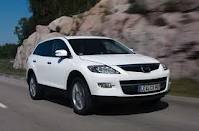
Mazda CX9 provides SUV roominess and comfort for six on the inside, with a sleek appearance that has high emotional appeal. This effect is created by a silhouette with a flat windscreen angle, thin tapered windows, large fenders and a rising belt line. At the front, the new CX9 emphasises power and build quality with a big front bumper, sleek headlamps with silver-look edges that wrap into the fenders, and a sculptured bonnet. The rear design features a five-point rear window and a large rear bumper for stability and strength. To this it adds sporty touches like a roof spoiler, dual trapezoidal exhaust pipes and 10-spoke, 20-inch aluminium alloy wheels (depending on market). Insightful details like the silver-look mouldings for the lamps, the chrome used for the grille bar and front intake areas and available turning signals in the side mirrors, all add a sense of prestige to owning a new Mazda CX9.
Interior Design - Roominess and Quality
Despite looking more like a sports car than an SUV on the outside, on the inside Mazda CX9 uses its full size - with a length of 5,089 mm, a width of 1,936 mm and height of 1,728 mm - to deliver SUV roominess, high quality craftsmanship and materials. Occupants are greeted by decorative, wood-like embellishments on each side of the centre console and at both ends of the dashboard. The cockpit has a driver cluster with black-out meters, indirect illumination and silver rings. Its leather seats (depending on market and grade) have a sporty look, are firm and durable, with high-quality stitching and are matched to trim materials with superior quality feel and silver accents throughout. Two interior colour packages are available, in either black or sand.
The new Mazda CX9 offers a long list of standard features. This includes an all-new 3.7-litre V6 engine coupled to a 6-speed automatic transmission with manual shift mode and Active Torque-Split all-wheel drive. Also available (depending on market) are a burglar alarm, privacy windows, power windows front and back, power adjustable and heated front seats and driver's seat memory function (for up to five settings). Other available features include three-zone heating and air conditioning, a premium BOSE®, 10 speaker 277 W audio system with Centerpoint® surround system and AudioPilot® noise compensation, rain sensor and auto light systems, and an Advanced keyless entry and start system for unlocking all four doors automatically from outside the car. The card key also operates the power rear liftgate. Combined with the high level of craftsmanship and build quality of Mazda's flagship SUV, and you have an overall package that stands out in the non-premium SUV segment.
Superior NVH for a Quiet Cabin
All these features can be enjoyed to the fullest, because CX9's cabin is designed to be quiet and relaxing, even at cruising speed on the motorway. Its new V6 engine and automatic transmission are smooth and quiet (see Powertrain below). And it supplements this with noise-suppressing foam applied at 22 locations in the body shell - the most of any Mazda vehicle ever - and various structural technologies which effectively dampen road and wind noise from reaching the cabin.
Roominess, Comfort and Seat Variability
The dynamic exterior of the Mazda CX9 is not achieved by sacrificing SUV comfort and seat flexibility. With one of the segment's longest wheelbases (2,875 mm), the Mazda CX9 offers space for a maximum of six people. The cockpit is designed to support this by being easy to use and practical. The steering wheel is both tilt and telescopically adjustable. The leather driver's seat is power adjustable for slide and height, has electric lumbar support adjustment and a seat position memory system that can store up to three different driving positions and two additional positions using the two card keys - and the front passenger seat is power adjustable as well. The shift lever of the six-speed automatic transmission is positioned high at the front of the floor console where it can be easily operated in either automatic or manual modes, and the steering wheel has audio controls and cruise control (depending on market). This is combined with large and comfortable back seats that can be folded individually to create a large load space. There is even a handy strap at the back of both third row seats that lets you fold them into the floor and lets you pull it back up again. And of course practical storage compartments can be found everywhere in the cabin. There is a large front floor console that comes with an auxiliary jack (AUX) for hooking up and playing an MP3 player using the car's premium audio system; and a 12-volt power outlet that can be used to recharge the batteries of your notebook, mobile phone and other electrical equipment.
Powertrain - Smooth and Powerful
The powertrain for the Mazda CX9 was chosen specifically to support the vehicle's high quality look and feel with an exhilarating yet sophisticated driving experience. Under the bonnet is a new MZI 3.7-litre V6 petrol engine that produces 204 kW/273 HP (SAE-NET) of maximum power at 6,250 rpm, and a robust 366 Nm of torque at 4,250 rpm - making it the most powerful engine in the Mazda line-up.
This 60° short-stroke V6 has a die-cast aluminium block with cast-in iron cylinder lines and aluminium cylinder heads - for minimal weight and high durability - and it adds advanced engine technologies to optimally combine performance with acceptable fuel consumption. These include sequential valve timing (S-VT) for optimised engine torque at all speeds. It also has a high compression ratio of 10.3:1 and electronic throttle control, which helps provides instant response to pedal input for lots of driving fun. Two catalytic converters make sure the Mazda CX9 meets Euro Stage IV emission standards.
Yet despite its fun-to-drive nature, the MZI 3.7-litre V6 has low NVH levels for a crossover SUV. To achieve this, a highly rigid cylinder block is used to reduce engine vibration, the side frame engine mounts are reinforced to reduce transmission vibration, and the forged-steel crankshaft has a dual-mass damper for smooth operation. Camshaft vibration is kept to a minimum by the use of sprockets with rubber cushion rings, and the intake manifold is designed to reduce intake air undulation and resistance.
Six-Speed Automatic Transmission with Manual Shift Mode
These engine technologies are combined with a six- speed automatic transmission with manual shift mode as standard equipment. This transmission provides an optimal balance between acceleration, ride comfort and quietness. Broad gear ratios ensure lively acceleration and smooth, powerful cruising speed, while the top two gears are laid out as overdrive, which helps save fuel when driving on the motorway. In automatic mode, it delivers a sporty shift feel and quick response to pedal input, and near manual-like shift characteristics in manual shift modes, for the best of both worlds.
Chassis & Safety - Responsive and Safe
Mazda CX9's stiff body shell and chassis systems - combined with the smooth, cultivated power of its V6 engine - make for an exciting driving experience not usually found on an SUV this size. And these superior dynamic attributes play a major role in making the CX9 something special in its class.
Zoom-Zoom Handling
The Mazda CX9 body shell has a highly rigid structure in the lower body with multiple cross members under the floor, a reinforced upper body area at the C-pillar, a high-tensile steel B-pillar and special roof reinforcements. This structure is made even more robust by the incorporation of crossing seat frames between the cross member of the floor and by the use of more laser spot welds and weld bonds than most of its competitors. All this results in high torsional and flexural rigidity, which delivers superior stability and Zoom-Zoom handling - without making Mazda's flagship SUV unduly heavy.
Its McPherson strut front suspension uses a 6-point rubber mount perimeter frame. This gives strong support and a sharp, linear feel to its hydraulic power assist rack-and-pinion steering system. The multi-link rear suspension employs one trailing arm and two lateral locating members on each side, and a rear frame with two rubber mounts on each side. The connecting points of the trailing arms are placed higher than usual, which further improves their stability during braking. The link layout is optimised to provide consistent wheel alignment when external forces are acting on the rear suspension, for predictable handling.
Superior Traction - Mazda's Active Torque-Split All-Wheel Drive
A main contributor to the predictable handling of the Mazda CX9 is its Active Torque-Split All-Wheel Drive system that provides traction in all road situations. Based on the system used by the Mazda CX-7; it monitors road conditions, ABS/DSC operating conditions, wheel speed and engine operation to optimise torque between the front and rear wheels (between 100:0 and 50:50). Depending on these factors, the system automatically selects snow mode or normal mode, and torque is distributed to the front and rear wheels by the coupling unit for optimised traction.
High Levels of Safety
Mazda CX9 is also one of the safest SUVs. Active safety features include a high seating position for great all around visibility, large front and rear ventilated disc brakes (320 mm and 325 mm respectively) combined with roll stability control (RSC), ABS, emergency brake assist (EBA), electronic brake-force distribution (EBD) and DSC (depending on market and grade). The foundation for Mazda CX9's passive safety system is its body shell. Using high-tensile steel and large-section body members, it disperses impact energy away from the passengers and keeps body deformation to a minimum during a collision. Also onboard is a special front sub-frame extension designed to help prevent the front of the Mazda CX9 from climbing up the front of an on-coming vehicle in a head-on collision. Passengers are further protected by front, side and three- row curtain airbags (depending on market and grade), three-point seat belts with pretensioners and load-limiters for the front seats, a collapsible brake pedal and specially designed front head restraints that help reduce possible neck injuries during a rear impact. No wonder the Mazda CX9 received the highest possible ranking of five stars on frontal and side impact crash testing from the U.S. government's National Highway Traffic Safety Administration (NHTSA), and a four-star rollover resistance rating.
Skoda Citigo
Škoda is continuing its product offensive by introducing its seventh model line. With the Škoda Citigo, at 3.56m long, the Mladá Boleslav automaker is entering the A00 segment. The Škoda Citigo will debut on the domestic Czech market by the end of 2011. Other European countries will follow at the beginning of summer 2012. The Škoda Citigo offers maximum utilisation of space and seats for four passengers. The Škoda Citigo will be launched as a three-door, with a five-door version to come in 2012.
"The Škoda Citigo is one of the pillars of our growth strategy. It paves the way for our brand to enter a very promising segment," said Škoda Board Chairman Prof. Dr. h.c. Winfried Vahland "The new product fully meets the corporate philosophy of the Škoda Brand expressed through the "Simply Clever" slogan. Despite its small size, it offers ample interior space, but is surprisingly agile, and attractive in terms of trims and technologies used. Although the Škoda Citigo is a small car, it is a typical Škoda—and as such fits perfectly with our plans."The designers managed to give the car a distinct look that declares at first glance: this is the new Škoda. The finned grille set in a chrome-plated frame and precisely shaped headlamps give the car the typical Škoda look. The designers have done a fantastic job on the rest of the car's body. With a length of 3.56 metres, width of 1.65 metres and height of 1.48 metres, the Škoda Citigo is one of the smallest vehicles in its segment. The volume of the luggage compartment is 251 litres. It can be extended to 951 litres by folding down the rear seats.
The key target groups are young drivers, young families looking to get themselves a second or even third car, and also "best agers." They are customers who are rather cost-sensitive and have a rational approach to cars on the one hand but high demands for quality, practicality, design and safety on the other. Škoda did not have much to offer such groups of customers in the small car segment. Prof. Vahland: "We can see that the demand for small cars with low fuel consumption, at a favourable price and with reasonable operating costs is growing. Škoda's new small vehicle is a reaction to this trend. We are entering new ground and the Škoda Citigo will attract a lot of customers mainly in our European markets. "The Škoda Citigo places great emphasis on safety. For the first time in a Škoda vehicle, the designers have used a Head-Thorax side airbag to protect the heads of both the driver and the front seat passenger and together with other elements it forms an exemplary safety packet in its class. In addition, active safety is significantly enhanced by the new "City Safe Drive" brake assistant. The system is automatically activated at speeds below 30 km/h and a laser sensor identifies a danger of collision. Along with the Volkswagen up!, the Škoda Citigo is currently the only car in the small vehicle segment to offer the emergency braking functionality.
Two new, three-cylinder 1.0-litre petrol engines will be available after the Škoda Citigo's launch: both have a volume of 1.0 litre and their power
outputs are 44 kW/60 HP and 55 kW/75 HP. In the economical Green Tec version average consumption is 4.2l/100km and 4.3l/100km respectively. Emissions are 97g and 99g CO2/km respectively. Fuel consumption and emissions are 4.5l/100km and 105g CO2 per km for the 44kW engine. The engine with a power output of 55kW consumes 4.7l/100km and emits 108g of CO2 per km.
Tuesday, September 20, 2011
2012, Toyota Fortuner Facelift pave in India
Once introduced to the international automobile market, Toyota Fortuner Facelift India ready to be presented in early 2012.
Currently, Toyota Fortuner Facelift is being produced which will be marketed in New Delhi, India. So that was launched Motorbeam, Sunday (09/18/2011).
Latest Fortuner for the Indian market is more mature than Toyota's SUV family. Engine options are still using the 3.0-liter motor, but there autobox which is a differentiator from previous generations.
Fortuner is available in two variants, manual and automatic. The plan is available for the 4x2 version is sold at lower prices Indian automotive market.
Fortuner also features a touch screen system for DVD, front and rear lights with a display and the latest technology, as well as rear bember more elegant.
As a matter of price, Toyota is still secret. But before the sale in the Indian market, this car will be exhibited first at the Auto Expo 2012 event in January 2012.
Use the 2013 Chevrolet Malibu 2.5L Ecotec engine
General Motors is preparing a major project in the design of the Chevrolet Malibu 2013. GM will take off Malibu in all major markets and 100 countries worldwide.
If the 2013 Chevrolet Malibu sold all over the world, certainly the engine lineup will vary in each country. Only this time GM is still focusing on the model which was released in the U.S. and attended in 2012.
General Motors Malibu engine detailing detail using the all-new 2.5-liter four-cylinder Ecotec. This machine takes the details from the old 2.4-liter model. This unit is expected to produce 190 horsepower and peak torque of 180 lb-ft (250nm).
Chevrolet Malibu 2013 will emphasize the economic value on the highway. Expected to consume more than 30mpg, or about 7.8 liters per 100 kilometers.
"The intensity of the noise that existed at the 2.4-liter engine has been reduced by 40 percent. 2.5L engine provides more torque at low rpm while. This makes the Malibu is stronger at the beginning or during the opening maneuver," said Mike Anderson GM engineering chief.
Thursday, August 25, 2011
Audi A8 Hybrid 2013
The power of a six-cylinder model, the fuel consumption of a four-cylinder version: Audi will be starting series production of the Audi A8 hybrid in 2012. Its gasoline engine - a 2.0 TFSI - and an electric motor develop peak output of 180 kW (245 hp) and 480 Nm (345.03 lb-ft) of torque. Average fuel consumption is below 6.4 liters per 100 km (36.75 US mpg). The sedan can travel at speeds of up to 100 km/h (62.14 mph) on electric power alone, and cover around three kilometers (1.86 miles) with zero local emissions at a constant speed of 60 km/h (37.28 mph).
The Audi flagship model is designed as a highly efficient parallel hybrid. The 2.0 TFSI, which has been modified in some areas, generates an output of 155 kW (211 hp) and 350 Nm (258.15 lb-ft) of torque, which is available between 1,500 and 4,200 rpm. The combustion engine works together with a disc-shaped electric motor which develops 40 kW (54 hp) and 210 Nm (154.89 lb-ft).
The permanent magnet synchronous motor is mounted in the space usually occupied by the torque converter in front of the modified eight-speed tiptronic. A multi-plate clutch that operates in an oil bath connects or disconnects the electric motor and the TFSI engine. The clutch operates ultra-precisely and gently in all situations. The highly comfortable and fast-shifting hybrid transmission guides the torque to the front wheels; with its wide gear spread it contributes to the efficiency of the Audi A8 hybrid.
The short-term system output of 180 kW (245 hp) and the system torque of 480 Nm (354.03 lb-ft) ensure highly agile performance. The Audi A8 hybrid reaches 100 km/h (62.14 mph) in 7.7 seconds from a standing start and has a top speed of 235 km/h (146.02 mph). Its fuel consumption in the EU cycle is less than 6.4 liters per 100 km (36.75 US mpg), and CO2 emissions are below 148 grams per km (238.18 g/mile). Please note that all figures are provisional.
The Audi A8 hybrid can drive at up to 100 km/h (62.14 mph) purely on electric power and has a range of up to three kilometers (1.86 miles) at a constant 60 km/h (37.28 mph). This gives the driver the choice of three modes: The EV characteristic map gives priority to the electric drive, while the D mode efficiently controls both the engine and the electric motor. The S mode and the tiptronic gate are designed for a sporty driving style. The hybrid sedan has five operating states: with the TFSI engine alone, with electric drive only or in hybrid mode; recuperation and boosting are also possible. Two displays show the driver all operating modes in detail.
The lithium-ion battery, which weighs 36.7 kilograms (80.91 lb), is located in a crash-proof area in the trunk. It provides 1.3 kWh of nominal energy and up to 40 kW of power. Two different methods are used to air-cool the battery, depending on need: with air blown from the passenger compartment by a fan and via a separate cooling circuit coupled to the automatic air conditioning system. The battery is thus kept within the temperature window required for it to perform to its full potential over a wide range. The electric motor and the compact power electronics which serve as a controller between the electric motor and the battery are water-cooled.
In visual terms, the Audi A8 hybrid is distinguished by subtle details. The ten spokes of its alloy wheels - which have a diameter of 18 inches as standard and 19 inches as an option - are reminiscent of turbine blades. The body features hybrid badges, and Arctic Silver is available as an exclusive paint finish. The metallic paint finish, three-zone automatic air conditioning, LED headlights and the BOSE sound system come standard.
Thanks to the brand's ultra-lightweight construction expertise, the Audi A8 hybrid will be one of the lightest sedans in its category. Its ASF (Audi Space Frame) body is made entirely of aluminum, while the B-pillars are of hot-shaped, ultra-high-strength steel. Weighing just 231 kilograms (509.27 lb), it is roughly 40 percent lighter than a comparable steel construction.
Toyota Camry Daytona 500 Pace Car
Toyota Motor Sales, U.S.A., Inc. (TMS) and Daytona International Speedway (DIS) announced the all-new 2012 Toyota Camry will serve as the official pace car for next year's DAYTONA 500®.
Toyota will showcase the new Camry -- the best-selling car in America for nine years running -- at Daytona in 'The Great American Race,' Feb. 26, 2012. The race annually kicks-off the NASCAR Sprint Cup Series season.
"We're thrilled to be able to feature the new Camry in Daytona at the season's biggest race," said Ed Laukes, TMS corporate manager of motorsports marketing. "We think the DAYTONA 500 is the perfect place to showcase the all-new Toyota Camry -- which will go on sale this fall. We knew when the opportunity arose to partner together with Daytona that it would be an extraordinary way to highlight our new Camry, as well as reinforce Toyota's commitment to NASCAR and its fans."
Toyota Camry went on sale in 1983 and since then more than nine million have been sold in the U.S. Camry has been the best selling car in America for 13 of the past 14 years.
This year marks the 25th anniversary of Camry production in Georgetown, Ky. Toyota began manufacturing the Camry in Georgetown in 1986 and the vehicle is now also built in Lafayette, Ind.
The 2012 Camry debuts a bold, sophisticated new design with a more spacious interior, improved driving dynamics and an even quieter ride than before. The new model features class leading safety, fuel economy and multi-media technology.
"NASCAR and Daytona International Speedway provide a uniquely American platform for manufacturers to display their technology, innovation and overall automotive excellence," said Daytona International Speedway President Joie Chitwood III. "After nearly eight years of competing at NASCAR's highest level, I'm pleased to have the 2012 Toyota Camry pace the DAYTONA 500."
Toyota has previously provided pace vehicles at several NASCAR tracks, including Auto Club Speedway of Southern CaliforniaSM, Charlotte Motor Speedway, Chicagoland Speedway®, Dover (Del.) International Speedway, California's Infineon Raceway, Kansas Speedway®, Martinsville (Va.) Speedway®, Nashville Superspeedway, New Hampshire Motor Speedway, Phoenix International Raceway®, Richmond (Va.) International Raceway®, Wisconsin's Road America and Watkins Glen (N.Y.) International®.
In 2004, Toyota began participating in NASCAR competition by fielding Tundras in the NASCAR Camping World Truck Series (NCWTS). Three years later in 2007, Toyota began competing in the NSCS and the NASCAR Nationwide Series (NNS) with the Camry.
Toyota has won three consecutive manufacturer's titles in the NNS (2008-2010) with the Camry, and Toyota racers have earned one driver's title (Kyle Busch in 2009) and registered 60 race victories in the NNS. In NSCS competition, Camry drivers have earned 36 first-place trophies.
In seven seasons participating in the NCWTS, Toyota has captured five consecutive manufacturer's championships (2006-2010), and Tundra drivers have won driver's titles with Todd Bodine (2006 and 2010) and Johnny Benson (2008), and have earned 88 race wins.
At Daytona International Speedway, Toyota drivers have recorded eight NASCAR wins across NASCAR's three national touring series, including one NSCS win (Kyle Busch in 2008), two NNS wins (Denny Hamlin in 2008 and Tony Stewart in 2008) and five NCWTS wins. In 2008, Hamlin claimed Toyota's first-ever NSCS victory in a non-points qualifying event to determine the Daytona 500 starting lineup.
Ferrari 458 Spider
The new Ferrari 458 Spider joins the 458 Italia, widening the range of Ferrari's mid-rear engined V8s and offering the same uncompromising technological solutions, handling and performance in a refined open-top configuration. It is equipped with a Ferrari patented, fully retractable hard top, a world first for a sports car with this lay-out.
The 458 Spider is powered by Ferrari's naturally-aspirated, direct-injection 4.5 litre V8 which was nominated as the 2011 International Engine of the Year for its engineering excellence in terms of driveability, performance, economy and refinement. The power is transferred to the road by Ferrari's class-leading dual-clutch F1 paddle-shift transmission through the sophisticated E-Diff, itself integrated with the F1-Trac traction control and high-performance ABS for maximum handling dynamics.
Certain features, such as its accelerator pedal mapping and the damping of the multilink suspension, have been calibrated to guarantee maximum sportiness and absolute driving pleasure with the top down, in line with Maranello's exclusive spider tradition. Even the engine soundtrack has been honed to ensure that the car's occupants are completely captivated by the drop-top driving experience.
Entirely in aluminium, the hard-top solution adopted for the Ferrari 458 Spider offers a number of advantages over the traditional folding soft-top, including a reduction of 25 kg in weight and a deployment time of just 14 seconds. Fully integrated into the styling of the car, the hard-top was engineered to fit neatly ahead of the engine bay without compromising aerodynamics or the performance of the car. The small space needed to house the roof enables the designers to include a generous rear bench for luggage behind the seats.
The rear of the car is characterised by innovative forms with the buttresses designed to optimise the flow of air to the engine intakes and the clutch and gearbox oil radiators. For maximum comfort whilst driving top down the Ferrari 458 Spider features a generously-sized adjustable electric wind stop. The design was perfected to slow and diffuse the air in the cockpit, enabling normal conversation to be held even at speeds over 200 km/h.
New technical solutions adopted for the chassis guarantee identical levels of structural rigidity with the roof up or down. The result is a car that is truly exciting to drive, blending extreme performance with the responsiveness that has always characterised Ferrari's open-top berlinettas.
Monday, August 22, 2011
VolksWagen up
Volkswagen has redrawn the map of the small car world. The goal: to develop a small car with charisma, a small car with maximum space on a minimal footprint, a small car with the most fuel-efficient engines or an electric drive, a small car with intuitive infotainment and operating systems, a small car with the safety of a large car. The result is the new Volkswagen up! It measures a short 3.54 metres and is a specialist for everyday urban living that was thought through to the last detail. This car - like the larger Polo and the even larger Golf - will appeal to people of all ages and mobility wishes.
Affordable for everyone. In launching the up!, Volkswagen is not only putting a new car in motion; it is also redefining the parameters of customisation and financing. This means that along with clearly delineated equipment lines on the Volkswagen up!, new features will be offered such as up! boxes - e.g. box sets for shopping, long trips or for children on board. The up! will have an infotainment system that owners can tailor to their personal profiles using apps. And because a small car needs to be affordable, a new financing model known as AutoCredit2 that is exclusively tailored to VW up! buyers will offer greater financial freedom thanks to its flexible configuration options. And for many people, this will make the goal of driving a safe and economical new car more attainable than ever. Like the Beetle back in the 1950s, one could say that the Volkswagen up! is once again "democratising" car driving.
The up! will first be launched in the European market. It all starts in December 2011. There are 3 versions for different budgets and needs: take up! is the entry-level car, move up! the comfort-oriented one and high up! the top version. Directly at the car's market launch, there will also be 2 independent models based on the high up!: the up! black and the up! white.
New generation of engines
Debuting in the Volkswagen up! is a new generation of three-cylinder petrol engines. They output 44 kW / 60 PS and 55 kW / 75 PS. Combined fuel consumption as a BlueMotion Technology version (including a Stop/Start system): 4.2 l/100 km (60 PS) and 4.3 l/100 km (75 PS). Both of these 1.0-litre engines emit less than the 100 g/km CO2 limit. A natural gas engine with 50 kW / 68 PS with the same basic configuration will follow. Its combined fuel consumption of 3.2 kg/100 km (natural gas) is equivalent to a CO2 value of 86 g/km; as a BlueMotion Technology version the natural-gas powered up! even attains a low CO2 value of 79 g/km. There are also definite plans for an up! with an electric drive for the year 2013.
First small car with City Emergency Braking
An important new safety technology system is the optional City Emergency Braking. It is automatically active at speeds under 30 km/h, and it uses a laser sensor to detect the risk of an imminent collision. Depending on the vehicle's speed and the driving situation, City Emergency Braking can reduce accident severity by initiating automatic brake interventions - and possibly even avoid a crash. So far, the VW up! is the only vehicle in the segment to be offered with an emergency braking function for city driving.
Dimensions and styling for the world's metropolitan areas
With its noted 3.54 metre length and 1.64 metre width, the Volkswagen up! is one of the smallest four-seat cars. The Volkswagen is 1.48 metres tall. Its overall length consists of conspicuously short body overhangs and a very long wheelbase (2.42 metres) - a body layout that fully utilises the space available in the new design. Klaus Bischoff, Head of Design for the Volkswagen Brand says: "If the goal is to maximise space, the ideal form for a small car would be a rectangular box. In the up! we were able to sculpt such a box with a clean and powerful design that does not lose sight of space utilisation." The front end of the VW up! reveals much about the car's character. Klaus Bischoff: "The face is unmistakably that of a genuine Volkswagen, but with a very independent personality. Naturally, the familiar styling characteristics of our brand face can also be found on the up! - the emphasis of horizontal elements and the connection of the grille and headlights to form a band, the accents created by small angles and the characteristic light signature of the headlights. But more than on any of the other models, the Volkswagen up! definitely shows a smile. The up! is simply appealing, and it appeals in a simple way!"
Uncompromisingly good use of interior space
Space utilisation in the car is exceptionally good, because of its wheelbase - one of the longest in the segment - combined with an engine that is mounted well forward. Although the driver, front passenger and 2 rear passengers are travelling in a small car, it is by no means a cramped vehicle. On the contrary. Consider the boot: 251 litres are significantly more than is typical in the vehicle class of the up! When the rear seat is fully folded, cargo space even increases to 951 litres. These two values show that in its interior the Volkswagen up! will be a giant among small cars.
An interior design that is fun
Essentially, the up! interior has a very clean and well-organised layout. The new Volkswagen also offers numerous clever and detailed solutions, fun styling and a level of quality that will enhance the market segment. Especially high-end is the Dash Pad, an instrument pad extending crosswise in front of the driver and front passenger. Depending on the equipment line, either decor paint or one of the 5 body colours is used in the interior.
VW up! boxes - small things that make a big difference
The developers of the Volkswagen up! asked themselves whether everyday living with the car could be structured in a simpler and friendlier way. Their answer was a decisive yes! Because it is often the small things that make a big difference. And that is how the idea of the up! boxes came about. Small, lightweight boxes for a wide variety of situations and needs. Take the "kid box", for example, that was designed for parents with small children; it includes a bag for the thousand small items that are essential with small children; and of course a toy to cuddle with and a lunch box for the obligatory snacks. Other Volkswagen up! boxes will be called the "city box" and the "travel box". And their names are their agendas.
maps + more - the Portable Infotainment Device (PID)
For the first time in a Volkswagen, the maps + more system is now being offered, a mobile Portable Infotainment Device (PID). In the economically priced up!, this is a system that is equally economical and was developed to organise the navigation, telephone, information and entertainment areas. In cooperation with Navigon, one of the world's leading suppliers of navigation systems, a special solution was tailored to the up! which is affordable for all buyers - maps + more. The user simply snaps the PID into place above the centre console. Unlike many other similar systems of this type, maps + more melds with the car's network of systems much better: navigation, telephone and infotainment can now be controlled and viewed via the PID touchscreen, and the touchscreen can also be used to view important vehicle information, such as the visual display of the ParkPilot (controls the car's distance to the next vehicle). Apps specially developed for the VW up! also let users extend maps + more to meet their specific needs.
Subscribe to:
Posts (Atom)